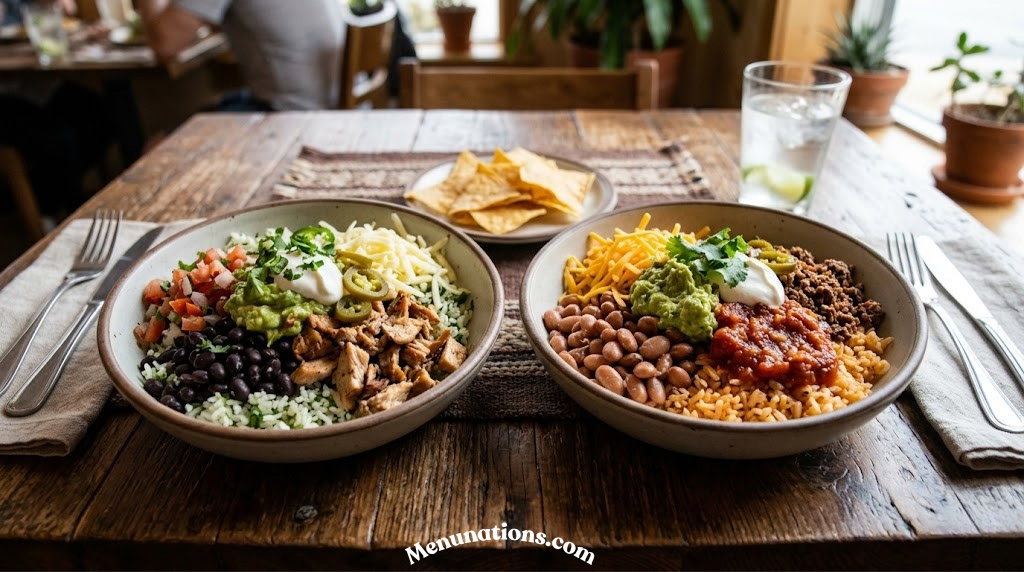
Chipotle vs Qdoba Menu Price: Which Bowl Actually Gives You More For Your Money?
A side-by-side breakdown of how these two build-your-own chains price their burritos, bowls, and sides — including the toppings that cost extra at one chain but come free at the other.
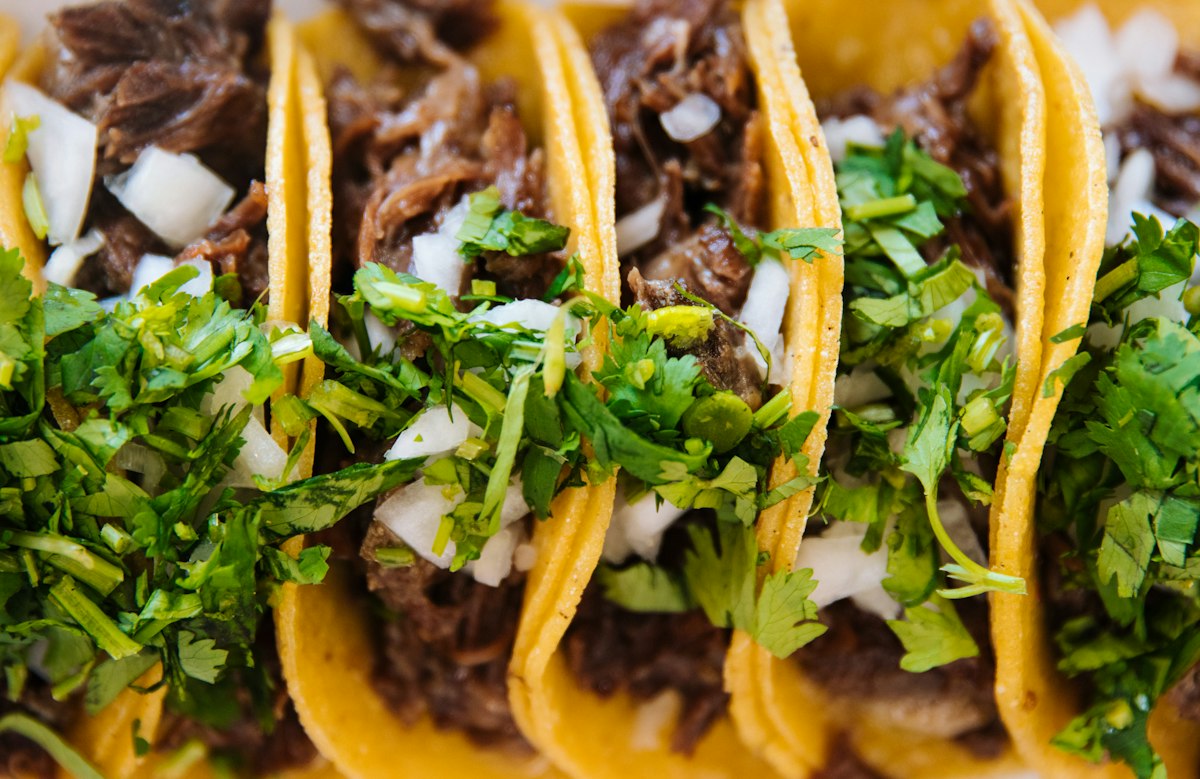
The Big Picture: How Pricing Differs
On the surface, Chipotle and Qdoba look like nearly identical concepts — a line, a tortilla or bowl, a row of proteins, and a wall of toppings you point at as you move down the counter. But the pricing philosophy behind that familiar format is actually quite different, and it shows up the moment you start asking for extras.
The short version: Chipotle keeps its base menu prices simple but charges separately for premium add-ons like guacamole, queso, and certain proteins. Qdoba, on the other hand, builds many of those same “extras” — queso, guacamole, and a wider topping bar — into the base price of most entrées, which can make the sticker price look higher upfront but often results in a similar or lower total once you’ve customized your order the way you actually want it.
This guide walks through both menus side by side: core entrée pricing, what’s included versus what costs extra, protein upcharges, the queso-and-guac question that comes up in basically every comparison thread, kids meals, sides, loyalty programs, and finally a real “build the same order at both places” cost comparison so you can see the difference in practice rather than in theory.
If you’re weighing this matchup against other build-your-own concepts, our full Chipotle menu guide goes deeper on the Chipotle side specifically, while the Subway menu guide covers a different build-your-own format (sandwiches rather than bowls) that follows its own pricing logic.
Why This Comparison Gets Asked So Often
Part of why “Chipotle vs Qdoba price” is such a recurring question is that both chains operate in the same general price tier — neither is a budget option, but neither is “premium fast casual” in the way a steakhouse or sit-down chain would be. That puts them close enough in overall cost that the differences come down to details: does your usual order include guac? Do you always add queso? Are you the type of customer who orders a “regular” bowl, or do you load up on every topping available? The answers to those questions can swing the comparison meaningfully in either direction, which is exactly why a line-by-line breakdown is more useful than a single “X is cheaper” headline.
Core Menu Prices Side-By-Side
Before getting into what’s included or extra, it helps to look at the base “entrée” price for the most common order types at each chain — a burrito, a bowl, tacos, and a salad.
| Entrée Type | Chipotle (Base Price Tier) | Qdoba (Base Price Tier) |
|---|---|---|
| Burrito | Mid-range, single protein included | Slightly higher base, but more inclusions |
| Bowl | Same as burrito pricing | Same as burrito pricing |
| Tacos (3-count) | Same tier as burrito/bowl | Same tier as burrito/bowl |
| Salad | Slightly higher than burrito/bowl | Comparable to burrito/bowl |
| Quesadilla | Premium tier, protein priced separately | Often bundled closer to entrée pricing |
Reading The Base Price Correctly
The base price at each chain represents two very different starting points. At Chipotle, the base price gets you a protein, rice, beans, and a modest set of toppings (salsas, lettuce, cheese) — anything beyond that, especially guac, queso, or a second protein, is an upcharge. At Qdoba, the base price for most entrées already includes access to a broader topping bar, often including queso as a no-extra-charge addition and a wider range of salsas and toppings without incremental fees. So a “higher” base price at Qdoba isn’t necessarily a worse deal — it may simply reflect more being bundled in from the start.
Chipotle Approach
À La CarteLower-looking base price, premium items priced separately
Qdoba Approach
BundledHigher-looking base price, more included by default
What’s Free vs. What Costs Extra
This is the section that decides most people’s opinion on “which is cheaper,” because it’s where the two chains diverge the most sharply.
Chipotle: What’s Included By Default
- One protein (chicken, steak, sofritas, carnitas, or barbacoa — though some proteins carry their own upcharge)
- Rice (white or brown)
- Beans (black or pinto)
- Salsas (mild, medium, hot, tomatillo-based options)
- Lettuce, fajita veggies, cheese
- Sour cream
Chipotle: What Costs Extra
- Guacamole — a standalone upcharge, one of the most consistently cited “extra” costs
- Queso — also an upcharge, not included by default
- Double protein — priced as roughly the cost of a second protein portion
- Certain “premium” proteins may carry a small additional charge over the base proteins
Qdoba: What’s Included By Default
- One protein
- Rice and beans (multiple varieties)
- Queso — often included at no extra charge on most entrées
- A wider salsa bar (multiple house-made salsas)
- Extended toppings: corn, pico, lettuce, cheese, sour cream, and more
- Free “extras” on toppings — unlike some competitors, Qdoba has historically positioned unlimited free toppings as a differentiator
Qdoba: What Costs Extra
- Guacamole — still typically an upcharge, similar to Chipotle
- Premium or specialty proteins (when offered) may carry an upcharge
- Double protein or “loaded” versions of entrées
Chipotle’s Pricing Logic
- Lower “headline” price attracts price-sensitive comparisons
- Works well if you don’t typically want queso or guac
- Predictable: you know exactly what you’re paying extra for
Qdoba’s Pricing Logic
- Queso included can offset the higher base price quickly
- Free unlimited toppings reward customers who load up
- Less “upcharge anxiety” at the register
For another example of how “free vs. paid extras” shapes a fast-casual menu’s perceived value, the Panera Bread menu guide covers a similar dynamic with soup-and-sandwich pairings and add-on pricing.
Protein Add-Ons & Upcharges
Protein choice is one of the more consistent cost drivers at both chains, and the upcharge structure follows a similar logic even if specific proteins differ.
Standard Proteins (No Upcharge)
At both chains, the most common proteins — typically grilled chicken and a seasoned ground or shredded beef option — are included in the base entrée price without any additional charge. These tend to be the “default” choices that anchor the advertised base price.
Premium Proteins (Upcharge Applies)
Steak is the most frequently cited “premium” protein at both chains, usually carrying a modest upcharge over the standard proteins. Specialty or limited-time proteins, when available, often fall into this same premium tier. The size of the upcharge tends to be fairly similar between the two chains — typically in the same ballpark rather than one being dramatically more expensive than the other for the same protein type.
Double Protein
Both chains allow ordering double protein (two scoops of the same or different proteins) for an additional charge, generally priced close to the cost of adding a second standard protein portion. If a recipe genuinely benefits from more protein — say, a high-protein bowl with extra chicken and steak — the upcharge is fairly predictable and similar across both menus.
| Protein Tier | Chipotle | Qdoba |
|---|---|---|
| Standard (chicken, seasoned beef) | Included in base price | Included in base price |
| Premium (steak, specialty) | Modest upcharge | Modest upcharge, similar tier |
| Plant-based option | Available, typically standard pricing | Availability varies by location |
| Double protein | Priced near a second protein portion | Priced near a second protein portion |

Carry Bowls Home Without The Mess
An insulated carrier helps keep burrito bowls upright and at temperature for the drive home — especially useful when ordering for multiple people.
Check Price on AmazonQueso & Guacamole Showdown
If there’s one line item that decides this comparison for most people, it’s queso and guacamole — the two “premium” add-ons that show up in nearly every online debate about which chain is the better value.
Guacamole: Roughly A Wash
Both chains treat guacamole as a paid add-on, and the pricing tends to land in a similar range at both — meaning guac alone usually isn’t the deciding factor in this comparison. If guacamole is a must-have for your order, expect a comparable upcharge regardless of which chain you choose.
Queso: Where Qdoba Pulls Ahead
This is the bigger differentiator. At Chipotle, queso is a standalone paid add-on — not part of any entrée by default. At Qdoba, queso has historically been positioned as included on many entrées at no additional charge, meaning if queso is part of your regular order, Qdoba’s “higher” base price can end up being the same as or cheaper than Chipotle’s “lower” base price plus a queso upcharge.
The Practical Takeaway
If your “usual order” doesn’t include queso or guac, Chipotle’s lower base price is likely to come out ahead in straight dollar terms. If queso is a non-negotiable part of your order — and for a lot of regulars, it is — Qdoba’s bundled approach often closes the gap entirely, and depending on local pricing, can even tip the comparison in Qdoba’s favor for that specific combination.
Bowls vs. Burritos: Value Math
A common question that’s only tangentially about the chain comparison: does choosing a bowl over a burritor (or vice versa) change the price? At both chains, the answer is generally no — bowls and burritos sit at the same base price tier, since the core components (protein, rice, beans, toppings) are identical; only the tortilla is added or removed.
Where The “Value” Difference Actually Comes From
Because bowls and burritos are priced the same at both chains, the real value differences come from elsewhere: portion consistency, how generously toppings are applied, and whether the format affects how much you eat. Some customers find that a burrito’s wrapped format makes it easier to eat the entire portion (nothing falls to the side of a container), while a bowl makes it easier to see — and sometimes leave behind — toppings that didn’t get evenly distributed. Neither effect changes the price, but it can affect how much “value” you feel like you got for the same dollar amount.
Tacos As A Lower-Commitment Option
Both chains offer a taco format (typically three smaller tortillas) at the same base price tier as a bowl or burrito. For anyone who wants to try multiple proteins or topping combinations in a single order without committing to one combination for the whole meal, tacos can feel like better value purely from a variety standpoint — even though the price doesn’t change.
For a different take on “format vs. price” in a build-your-own context, the broader Chipotle vs Qdoba comparison hub and the Subway menu guide both touch on how format choices interact with perceived value even when the underlying price doesn’t move.
Kids Meals & Family Value
Both chains offer a kids meal option, typically a smaller-portioned entrée (often a quesadilla, mini burrito, or small bowl) paired with a side and drink at a price point noticeably below the standard adult entrée.
Chipotle Kids Meal
Chipotle’s kids meal generally includes a choice of a smaller entrée (such as a kid-sized quesadilla, taco, or burrito) with one or two simple sides (like chips, a fruit pouch, or a small drink) at a price meaningfully lower than ordering an adult portion. The customization options are more limited than the adult menu, which keeps the kids meal simple for both parents and staff.
Qdoba Kids Meal
Qdoba’s kids meal follows a similar structure — a smaller entrée option with a side and drink at a reduced price point. Given Qdoba’s broader default inclusions on the adult menu, the kids meal sometimes reflects a similar “more included” philosophy, though the core value proposition (smaller portion, lower price, simplified choices) is consistent with Chipotle’s approach.
Family Ordering Strategy
For families ordering multiple kids meals alongside adult entrées, the cumulative savings from kids pricing can be meaningful — two kids meals plus two adult entrées will typically cost noticeably less than four adult-priced orders. If queso is part of the family’s regular order, Qdoba’s inclusion policy can compound across multiple entrées, making the gap between the two chains slightly more pronounced for larger family orders than for a single individual order.
| Aspect | Chipotle | Qdoba |
|---|---|---|
| Kids Entrée Options | Quesadilla, taco, or mini burrito | Similar smaller-format options |
| Included Sides | Chips, fruit pouch, or similar | Comparable side options |
| Price vs. Adult Entrée | Noticeably lower | Noticeably lower |
| Customization Level | More limited than adult menu | More limited than adult menu |
Sides, Chips & Drinks Pricing
Beyond the main entrée, sides and drinks round out the typical order — and pricing here is fairly comparable between the two chains, though the “default inclusions” pattern from the main entrées carries over in smaller ways.
Chips & Dips
Both chains sell bags of chips as a separate side item, often paired with a small portion of salsa, guacamole, or queso as a “chips and ___” combo priced as a bundle. These bundles are usually priced similarly to ordering the chips and the dip separately, so the “bundle discount” (if any) tends to be modest rather than dramatic at either chain.
Fountain Drinks
Standard fountain drink pricing is broadly comparable between the two chains, generally falling into the same price tier as most fast-casual fountain drinks. Neither chain stands out as significantly cheaper or more expensive on beverages specifically.
Bottled Beverages
Both chains offer bottled options (water, sparkling water, juices, or specialty drinks depending on location) at a modest premium over fountain drinks — again, broadly similar in price range between the two.

Portion Out Extra Sauces At Home
Small reusable containers are handy for splitting a single queso or guac order into multiple portions if you’re sharing across a group.
Shop Containers on AmazonLoyalty Apps & Recurring Deals
Both chains operate loyalty/rewards programs through their respective apps, and for regular customers, these programs can meaningfully shift the long-run value comparison beyond what a single-order price comparison shows.
Chipotle Rewards
Chipotle’s loyalty program is points-based — purchases earn points that accumulate toward free menu items or rewards. The program also frequently surfaces personalized offers and occasional limited-time promotions through the app, which can offset some of the “extras cost more” dynamic for app users who pay attention to current offers.
Qdoba Rewards
Qdoba similarly runs a rewards program through its app, with points or credit accumulating toward free items over time. Given Qdoba’s “more included by default” pricing approach on the base menu, app-based promotions can stack on top of an already more-inclusive starting point, which is part of why loyal Qdoba customers sometimes report feeling like they get more for the same spend over time.
Why Loyalty Programs Matter For This Comparison
A single-visit price comparison doesn’t capture the effect of accumulated rewards, birthday offers, or app-exclusive promotions — all of which can meaningfully change the effective cost per visit for a regular customer at either chain. If you’re choosing between the two as a “regular spot,” it’s worth signing up for both apps initially and tracking which one’s offers align better with your actual ordering habits before settling into one as your default.
For more on how loyalty programs shape value at other chains, the Starbucks vs. Dunkin’ comparison and the McDonald’s secret menu guide both touch on how app-based rewards interact with menu pricing.
Portion Sizes: Do You Get More Food?
Price per item only tells part of the story — portion size affects the actual “value per dollar” in a way that’s harder to quantify but matters in practice.
Rice & Beans Portions
Both chains use a standardized scoop system for rice and beans, and in practice, portion sizes for these base components tend to be broadly similar between the two — neither chain is widely known for dramatically over- or under-portioning rice and beans compared to the other.
Protein Portions
Protein portioning is one area where individual location consistency can vary more than the chain-level policy — both chains use standardized scoop sizes, but how generously staff apply that standard can differ location to location. This makes protein portioning more of a “your local restaurant” factor than a “this chain vs. that chain” factor.
Toppings & The “Free Extras” Effect
This is where Qdoba’s “free unlimited toppings” positioning can meaningfully increase effective portion size — if you’re someone who likes extra lettuce, extra salsa, extra corn, and so on, and those extras come at no charge, your effective food volume per dollar increases compared to a chain where some of those extras might carry incremental charges or stricter default portions.
Chipotle
ConsistentStandardized portions, predictable across visits
Qdoba
Generous ExtrasFree topping additions can boost effective portion size
Total Meal Cost: A Real Order Comparison
To make this concrete, here’s how a fairly typical “loaded” order compares at both chains — a chicken bowl with queso and guacamole, a drink, and a side of chips.
| Order Component | Chipotle | Qdoba |
|---|---|---|
| Base Bowl (Chicken) | Base price | Base price (slightly higher tier) |
| Queso | + Upcharge | Often included No Extra |
| Guacamole | + Upcharge | + Upcharge (similar amount) |
| Chips (side) | + Standard side price | + Standard side price |
| Fountain Drink | + Standard drink price | + Standard drink price |
| Estimated Total | Base + 2 upcharges + sides | Higher base + 1 upcharge + sides |
Reading This Comparison Honestly
In this specific “loaded” scenario — queso AND guac, which is a common order for regulars who like both — Qdoba’s bundled queso can offset a meaningful portion of its higher base price, often bringing the two totals closer together than the headline base prices alone would suggest. If guac is dropped from the order, Chipotle’s lower base price combined with one fewer total upcharge tends to pull ahead more clearly. And if neither queso nor guac is part of your order at all, Chipotle’s simpler, lower base price is generally the more straightforward “cheaper” option.
The Order That Changes Everything: No Extras At All
For a “plain” order — protein, rice, beans, basic toppings, no queso, no guac, no double protein — Chipotle’s lower base price has less to be offset by, since Qdoba’s included extras aren’t being used. In this scenario, Chipotle is generally the more straightforwardly affordable option, since you’re not paying for (or benefiting from) any of the bundled inclusions that make Qdoba competitive in the loaded-order scenario above.
Chipotle Wins When…
- Your order is simple — no queso, no guac, single protein
- You value predictable, lower headline pricing
- You’re comparing strictly on a “plain bowl” basis
Qdoba Wins When…
- Queso is a must-have on your order
- You like to load up on free toppings and extras
- You’re ordering for a family and the bundled inclusions compound
How They Compare To The Rest Of The Category
Stepping back, it’s worth placing this Chipotle-vs-Qdoba comparison within the broader fast-casual and quick-service landscape, since “build-your-own” isn’t the only model competing for the same lunch budget.
Versus Burger & Sandwich Chains
Compared to traditional burger or sandwich combo pricing — covered in guides like our McDonald’s menu guide, Burger King menu guide, and Wendy’s menu guide — both Chipotle and Qdoba generally sit at a higher base price point for a single entrée, but with significantly more customization and (in Qdoba’s case especially) more bundled inclusions than a standard combo meal typically offers.
Versus Other Chicken-Forward Fast Casual
If chicken specifically (rather than the burrito-bowl format) is the priority, our Chick-fil-A menu guide and the KFC vs. Popeyes comparison represent a different pricing model entirely — set menu items with combo pricing rather than the à la carte/bundled approach that defines this matchup.
Versus Other Build-Your-Own Concepts
The “base price plus selective upcharges vs. bundled inclusions” tension isn’t unique to Chipotle and Qdoba — it shows up across the fast-casual category broadly. Comparisons like Five Guys vs. Shake Shack and In-N-Out vs. Five Guys explore a similar dynamic in the burger space, where “free toppings” versus “premium add-ons” plays out in comparable ways.
International Build-Your-Own Comparisons
This “included vs. upcharge” pricing tension also appears internationally in different forms. Popeyes’ Singapore menu and Greggs in the UK both reflect how regional pricing norms shift what counts as “included” versus “extra” in a given market — useful context if you’re comparing value perceptions across countries rather than just within the U.S. fast-casual space.
| Category | Typical Pricing Model | Where Chipotle/Qdoba Fit |
|---|---|---|
| Burger/Sandwich Combos | Fixed combo price, few customizations | Higher per-entrée, more customizable |
| Chicken Quick-Service | Set menu items, combo pricing | Different model entirely — à la carte build |
| Other Build-Your-Own | Mixed: some bundle, some upcharge | Chipotle = upcharge-heavy; Qdoba = bundle-heavy |
Frequently Asked Questions
Is Chipotle or Qdoba cheaper overall?
It depends on your order. For a simple entrée with no queso or guacamole, Chipotle’s lower base price tends to be cheaper. For an order that includes queso, Qdoba’s tendency to bundle queso into the base price can make the totals comparable or even favor Qdoba.
Does Qdoba really include queso for free?
Qdoba has historically positioned queso as included on many entrées at no additional charge, which is a key difference from Chipotle, where queso is consistently a separate paid add-on. Policies can vary by location and over time, so it’s worth confirming in the app.
Is guacamole extra at both chains?
Yes, both Chipotle and Qdoba typically charge an upcharge for guacamole, and the pricing tends to be in a similar range at both, so guac alone usually isn’t the deciding factor between the two.
Are bowls cheaper than burritos at either chain?
No, bowls and burritos are priced the same at both chains since the core ingredients are identical — the only difference is whether a tortilla is included, which doesn’t change the price.
Which chain has better kids meal value?
Both chains offer kids meals at a noticeably reduced price compared to adult entrées, with similar structures (smaller entrée, side, and drink). Neither stands out as dramatically better on kids pricing specifically.
Does ordering double protein cost the same at both chains?
Generally yes — both chains price double protein additions similarly, roughly equivalent to the cost of a second standard protein portion.
Do loyalty apps make a big difference in price?
Over time, yes. Both chains run points-based rewards programs that can offset costs through free items and promotions, which matters more for regular customers than for a single one-off order comparison.
Is steak more expensive than chicken at both chains?
Yes, steak (and other premium proteins where offered) typically carries a modest upcharge over standard proteins like chicken at both chains, and the size of that upcharge tends to be similar between the two.
Which chain gives bigger portions?
Base portions for rice, beans, and protein tend to be broadly similar between the two chains. Where Qdoba can pull ahead is in free topping additions, which can increase effective portion size if you regularly ask for extras.
Are chips and drinks priced differently between the two?
Not significantly — sides like chips and standard fountain drinks fall into a similar price range at both chains, so they rarely factor heavily into the overall value comparison.
Does the price difference change for catering or large orders?
The same per-item dynamics (queso inclusion, protein upcharges) apply at scale, so for large family or group orders, the cumulative effect of Qdoba’s bundled inclusions can become more noticeable than it would be for a single individual order.
Is one chain a better “everyday” option and the other better for occasional treats?
Not inherently — the better “everyday” choice really comes down to your typical order. If your everyday order is simple, Chipotle’s lower base price suits frequent visits. If your everyday order includes queso, Qdoba’s bundling may make it the more economical everyday choice for you specifically.
So Which One Should You Choose?
There’s no single universal winner here — and that’s actually the most useful takeaway. Chipotle’s lower headline pricing rewards customers who keep their order simple, while Qdoba’s bundled-in extras, especially queso, can make its slightly higher base price a non-issue (or even an advantage) for anyone who routinely adds those extras anyway. The best move is to think about your own “usual order” — does it include queso or guac? Do you load up on toppings? — and let that answer guide which chain’s pricing model actually works in your favor.
For more build-your-own comparisons and fast-casual deep dives, check out our full Chipotle menu guide and the pizza chain showdown for more head-to-head menu breakdowns.
Shop Meal Prep Containers on Amazon